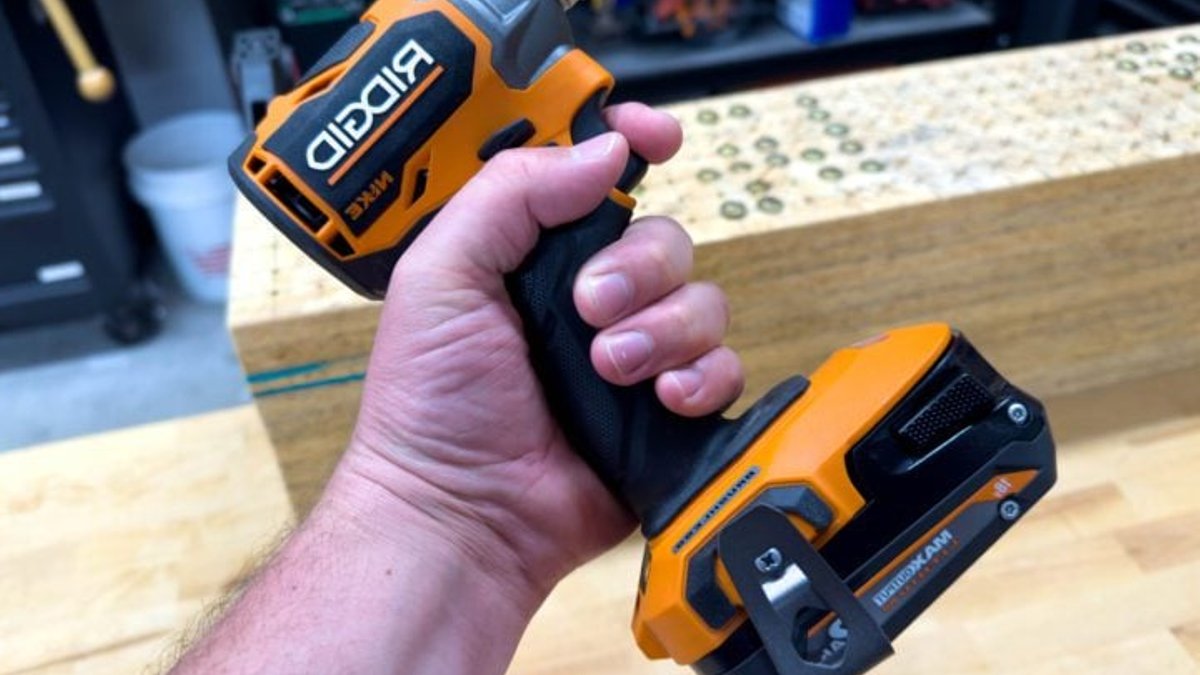
Ridgid’s latest 18V impact driver targets a specific crowd: professionals who need real fastening power but don’t want to haul around a heavyweight tool all day. The Nuke SubCompact Impact Driver (model RNKSID02) sits between the company’s previous generation compact model and its flagship, offering a middle path for light to medium-duty work.
What the Numbers Say
The RNKSID02 uses a brushless motor that pushes out up to 2,000 in-lbs of fastening torque. Top speed hits 3,800 RPM with an impact rate of 5,000 IPM. Those specs put it in the conversation with current flagship impact drivers, though the torque figure still trails the absolute top performers. That said, hitting 2,000 in-lbs wasn’t all that long ago considered the ceiling for the whole market.
Compared directly against the previous SubCompact model (R872311), the new tool shows real gains. Impact rate climbs from 4,200 to 5,000 IPM, torque rises from 1,850 to 2,000 in-lbs, and no-load speed jumps from 2,900 to 3,800 RPM. The flagship model (R862312) still leads with 2,400 in-lbs and 3,400 RPM, but the gap has narrowed considerably.
Testing Under Controlled Conditions
To see how this plays out in practice, two standardized tests were run comparing the new model against its predecessor and the flagship.
Related: DeWalt 12-Gallon Vacuum Earns Positive Review
The first test drives three 3/8-inch by 8-inch GRK Rugged Structural Screws into stacked, glued OSB subflooring. Each screw gets a 2-inch pilot hole, and completion times are averaged across all three runs. This isn’t the hardest fastening job out there, but it’s well above driving deck screws and requires a solid balance of speed, torque, and impact rate to stay fast without bogging down.
The RNKSID02 averaged 14.51 seconds per screw. That’s solid for a compact model, though it sits noticeably behind the flagship’s 6.83-second average. The trade-off makes sense given the weight difference—2.9 pounds with a 2.0Ah battery versus 3.4 pounds. The new tool didn’t strain during the test, and for most common applications, that performance level is more than adequate.
A second test shifts to breaking fasteners loose rather than driving them. Eight 1 1/4-inch lug nuts are torqued onto matching semi-truck studs at 150 ft-lbs (1,800 in-lbs) using a calibrated torque wrench. The impact driver then loosens all eight, with total time recorded and averaged.
At 1,800 in-lbs, every tested model should handle this task—the threshold is set to exclude underpowered tools. The Ridgid completed the full run in 1 minute and 18.6 seconds, averaging 9.8 seconds per bolt. The flagship? Just 1.9 seconds. The gap is real, but the question was whether it could be done, and the answer came back yes.
Related: Eco-friendly ACs compared for cost efficiency and features
For metal-to-metal fastening, the tool performs reliably. One thing to keep in mind: once you push into that 1,800 in-lbs torque range on hard-stop fasteners, adapters and nut driver bits start failing more often. Professionals who do a lot of metal fastening might actually find the mid-range torque helps them avoid snapping bits compared to running the flagship flat out.
Handling and Design
The bare tool weighs exactly 2 pounds, or 2.9 pounds with the recommended 2.0Ah battery. The head measures 4.5 inches tip to tail, down from the previous model’s 4.75 inches. That smaller profile makes a difference when working inside cabinets, electrical boxes, or other tight spots. The grip has generous rubber overmolding that sits comfortably in medium-sized hands, and the balance stays centered once the battery is attached.
The control panel sits at the base of the grip on the back of the foot—Ridgid’s choice over the more common front-foot placement. On impact tools, that rear position actually makes the controls easier to see while you’re working.
Two features worth noting: an LED light that illuminates bits and fasteners without casting harsh shadows, and an auto-eject collet that lets you drop hot bits with a single touch.
Related: Ryobi Launches Smaller Inflators With Full Power
Like the previous model, the RNKSID02 offers three main speed modes plus a self-tapping screw assist mode. That assist mode reduces the risk of overdriving or stripping self-tapping screws—something that matters if you’re working in HVAC, metal framing, or electrical installations where those screws come up regularly.
The RNKSID02 doesn’t try to outpace Ridgid’s flagship model, and that honesty works in its favor. It delivers consistent performance for light to medium-duty fastening while keeping weight and size down. For professionals who spend hours driving fasteners, that trade-off often makes sense.
HVAC technicians and electricians will likely find the most value here, along with serious weekend warriors who want solid performance without the extra pounds. Anyone regularly driving large structural screws or needing the absolute fastest completion times should look at Ridgid’s flagship instead.
The RNKSID02 currently ships only as part of a combo kit with the new Nuke hammer drill for $269. A single-speed version (RNKSID01) is also launching at $139 and includes a battery and charger for buyers who only need the impact driver. Both tools run on Ridgid’s 18V battery platform.
