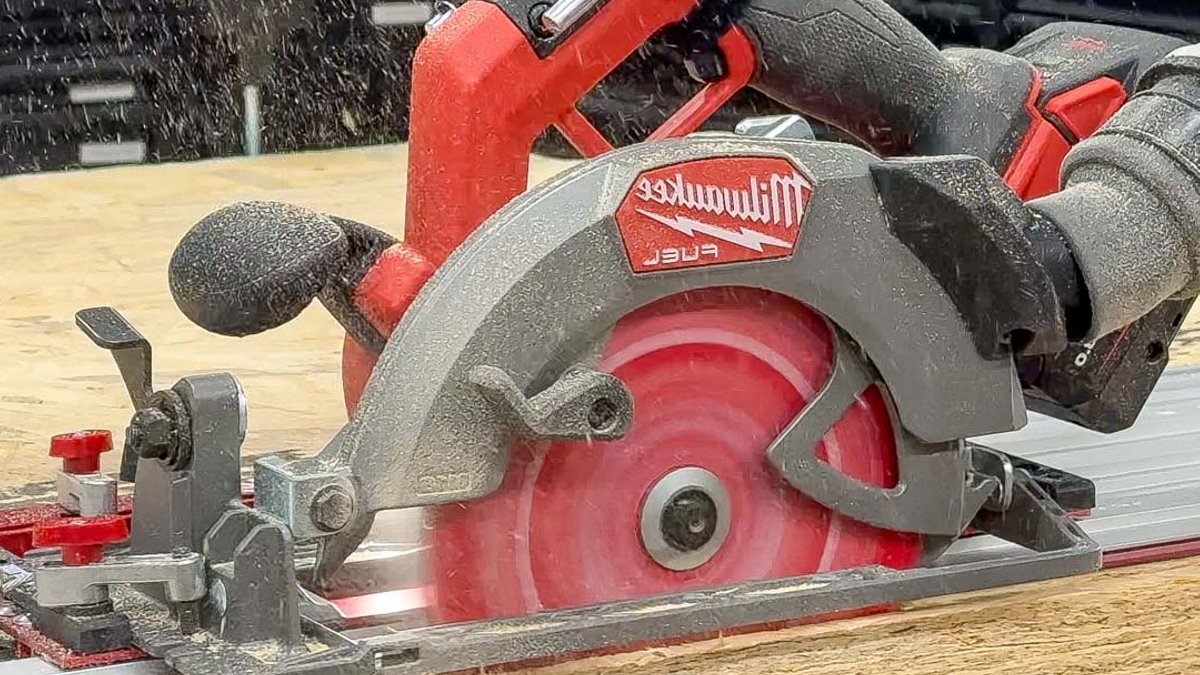
When Tom tested a lineup of popular cordless circular saws, the no‑load speed numbers ranged widely, prompting a closer look at whether those RPM figures actually predict cutting speed.
Blade speed and cut frequency
On paper, a faster‑spinning blade should engage its teeth more often. A typical 24‑tooth framing blade makes 24 cuts per revolution. At a rating of 5,000 revolutions per minute, that works out to 120,000 tooth contacts each minute. Bumping the speed to 5,800 RPM raises the count to 139,200, a 16 % jump. The math suggests a proportional gain in cut rate.
But the calculation assumes the blade stays at that speed under load, which rarely happens in real work.
Test rig and procedure
Tom built a sled that holds each saw in the same position on a track, then pulls the sled with a 10‑pound weight. The cut is a 7‑foot rip through two sheets of ¾‑inch OSB, a task that stresses the motor without overwhelming it.
A laser‑triggered timer records the start and finish, removing human reaction time from the measurement. The shortened length results from the timer placement rather than a limitation of the boards.
The full methodology and raw numbers are documented in the original review.
What the numbers reveal
Here are the fastest times alongside each model’s rated no‑load speed:
- Milwaukee 28349 – 9.76 seconds, 6,000 RPM
- Metabo HPT C3607DB – 10.10 seconds, 6,000 RPM
- Flex FX214 – 13.35 seconds, 5,800 RPM
- Makita GSH01 – 13.53 seconds, 6,000 RPM
- Hilti SC 30WR – 13.75 seconds, 4,700 RPM
- Ryobi PBLCS302 – 14.10 seconds, 5,000 RPM
- Kobalt KXCS 124B – 14.87 seconds, 5,500 RPM
- DeWalt DCS578 – 15.53 seconds, 5,800 RPM
- Skil CR5440B – 16.70 seconds, 5,300 RPM
- Craftsman CMCS551 – 17.67 seconds, 5,000 RPM
- Ridgid R865 – 18.72 seconds, 5,400 RPM
- Bosch GKS18V‑25N – 19.64 seconds, 5,000 RPM
In many cases, the higher speed rating aligned with a quicker cut, but the pattern wasn’t consistent. Hilti, with the lowest rating, still placed mid‑field, while Kobalt and DeWalt, both boasting relatively high numbers, fell behind peers with similar specs.
Read Also: Skil introduces versatile hex key for furniture assembly
That inconsistency points to another factor: torque. Torque helps a saw keep the blade turning when the material pushes back. In light cuts, little torque is needed, so a high speed rating often wins. In tougher cuts, torque becomes the deciding factor, and a saw that can hold its speed under load may outpace a faster‑rated competitor.
Because most manufacturers list only no‑load speed, buyers lack a clear picture of how well a tool will hold that speed when the motor is taxed.
Choosing a tool without torque specs
Without a standard torque rating for cordless saws, professionals must rely on other clues. One approach is to stay within a single battery ecosystem, ensuring the platform supplies enough power across all tools.
Another is to opt for the top‑tier model from a brand. Flagship units tend to combine the strongest motors with better battery management, delivering both speed and torque where it matters.
Finally, it’s worth noting that today’s high-end cordless saws often outperform older 15-amp corded models in real-world productivity.
While the data shows a general trend that higher rated speed can translate to faster cuts, the relationship is not linear. A saw that struggles to maintain its RPM under load will fall behind a slower‑rated tool that holds steady.
Looking ahead, manufacturers might consider publishing torque or power figures, as they do for drills and impact drivers. That would give users a more complete basis for comparison, especially as cordless technology continues to replace corded workhorses.
For now, the safest bet is to test a saw in the conditions you expect to face, or rely on brand reputation for robust performance under load.
